



The Small Cell Opportunities Across the Middle East and Africa
October 2026
Altman Solon is the largest global TMT consulting firm with expertise in telecommunications consulting. In this insight, we share our findings on small cell opportunities across the Middle East and Africa and outline how operators and infrastructure players can win in this market.
The rise of densification
The global small cell market is projected to grow from roughly $6.5 billion in 2025 to over $33 billion by 2031. Yet the Middle East and Africa (MEA) remain the last major region without dedicated densification infrastructure players, even as conditions for deployment are now falling into place across a growing number of markets. Densification is starting to become a high priority for infrastructure investors, and Altman Solon’s proprietary market modeling points to an addressable market of roughly 24,150 small cell sites across the region.
Where 5G creates densification demand
5G rollouts across MEA have accelerated since 2023. Tunisia and Morocco launched commercial 5G in 2025, Kenya has had it since 2021, and in the Gulf states, 5G has been live since 2019. These deployments have started to expose the capacity constraints of macro-only network architectures and are creating a surging demand for densification infrastructure. High-traffic outdoor environments (commercial districts, university campuses, transit corridors) need small cell densification to deliver the throughput and low latency that 5G promises.
Meanwhile, large indoor venues (the stadiums being built for the 2030 World Cup, expanding airport terminals, and new convention centers across the Gulf) require distributed antenna systems (DAS) solutions to serve concentrated crowds. Demand for both is growing in parallel.
The densification layer, both small cells and DAS, remains fragmented and largely operator-captive (owned and operated by mobile operators). As developed markets have shown, this is the stage where dedicated densification specialists begin to emerge.
Four factors that separate ready markets from the rest
Our analysis of upwards of 70 countries across the region, identifies four factors that determine if a market can support a viable small cell and DAS business:
-
Grid reliability is the primary filter. Small cells run on grid power. Unlike macro towers, they cannot economically support standalone power solutions.
-
5G maturity creates the demand trigger. Markets with active, multi-operator 5G networks generate immediate densification demand. Those still in planning or trial phases offer potential but not yet actionable opportunities.
-
Market structure and competitive openness determine the entry model. Market openness to independent densification matters more than what tower companies are present. Greenfield markets, where operators still retain their tower assets and no dominant infrastructure player exists, present the cleanest opportunity for an entrant.
-
FX stability protects returns. Infrastructure investments are capital-intensive and long-duration. Currency volatility can erode dollar-denominated returns even when operational performance is strong.
Seizing the opportunity: Altman Solon's MEA small cell forecast
To quantify the opportunity, our team developed a proprietary bottom-up market model covering close to 70 MEA countries. The model estimates the number of addressable small cell sites by country, based on urban area, target deployment density, grid reliability thresholds, 5G readiness, and market structure.
When the below four readiness dimensions are applied, these sites distribute across distinct market categories:
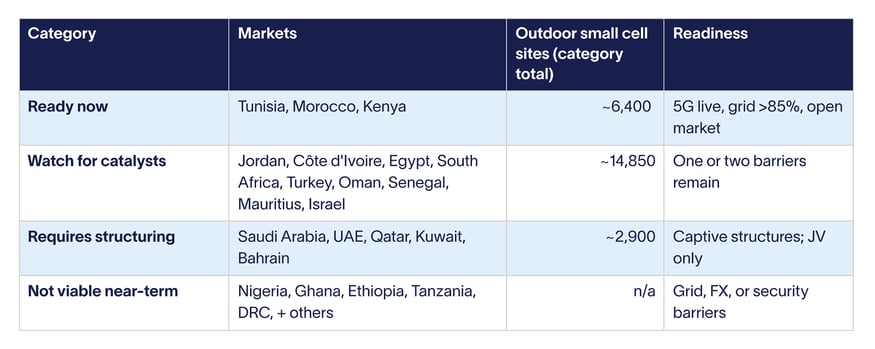
The near-term opportunity, mostly in Tunisia, Morocco, and Kenya, is around 6,400 sites. This estimate is deliberately conservative. It leaves out indoor DAS deployments and assumes lower site density benchmarks than developed markets have reached.
Who benefits, and how
The MEA densification opportunity will play out differently for different types of players:
- For MNOs, densification is coming whether they invest in it or not. The strategic choice is between building and owning small cell and DAS assets (keeping control but requiring capital), outsourcing to neutral host providers, or pursuing a hybrid model.
- For existing TowerCos, small cells are an adjacent growth opportunity that requires a different operating model: street furniture and building facades replace rural land parcels, grid power replaces diesel generators, and municipalities and property owners replace landowners as key counterparties. TowerCos with African experience have relevant foundations but must build new capabilities, or risk specialist entrants capturing the densification layer while they remain confined to the slowing macro market.
- For specialist densification providers, MEA represents a greenfield category-creation opportunity. A focused entrant that establishes positions in two or three ready markets can build operational track records and commercial relationships that become barriers to later entrants.
- For infrastructure investors, the risk-return profile is shaped by market selection: a portfolio concentrated in markets with strong grid reliability, active 5G, and stable currencies looks very different from one that chases scale in structurally challenging environments. Patient capital with a five-to-seven-year horizon and tolerance for emerging market complexity is best positioned.
How Altman Solon can help
Altman Solon provides advice on digital infrastructure to telecom operators, TowerCos, and investors in the space. With on-the-ground experience in more than 20 African countries, our proprietary market model underlying this analysis is one expression of a broader capability set we bring:
- Market assessment and sizing: country prioritization and city-level addressable market modeling for small cells and DAS, built on our bottom-up MEA model.
- Commercial and technical due diligence: transaction support for investors in densification and adjacent digital infrastructure assets.
- Market entry and business model design: neutral host economics, tenancy and lease rate benchmarking, build-versus-partner decisions, and joint venture structuring for captive markets.
- Deployment strategy: site density planning, rollout phasing, and site acquisition and permitting approaches for street-level infrastructure.
- Energy optimization: hybrid and renewable power strategies for grid-challenged markets, with demonstrated operating expense reductions of up to 35% and capital expenditure savings of up to 25%.
About this research
This whitepaper draws on in-depth research of urban density, grid reliability, 5G readiness, and market structure of approximately 70 countries. The propriety modeling estimates a total addressable market of 24,150 small cell sites across the MEA region.


Insights
Insights | August 2026
Insights | August 2026