


Investing Beyond Data Center Platforms
September 2026
Altman Solon is the world's largest telecommunications, media, and technology consulting firm. In this insight, we map data center (DC) investment opportunities into two categories.
Data center investing extends well beyond owning a platform operator. Across the value chain, from utilities and land acquisition to construction and day-to-day operations, there are services, hardware, software, and enabling infrastructures (e.g., on-site power generation) that offer a wide range of investor entry points. These adjacencies provide opportunities with different levels of accessibility, defensibility, and risk, and can serve as diversification plays, AI-derivatives plays, or strategic bolt-on M&A for existing portfolios.
Some adjacencies benefit primarily from the sector's continued baseline growth. Others are being fundamentally reshaped by technological shifts, such as the massive compute requirements and associated weight, cooling, fast lifecycle, and power implications of generative AI.
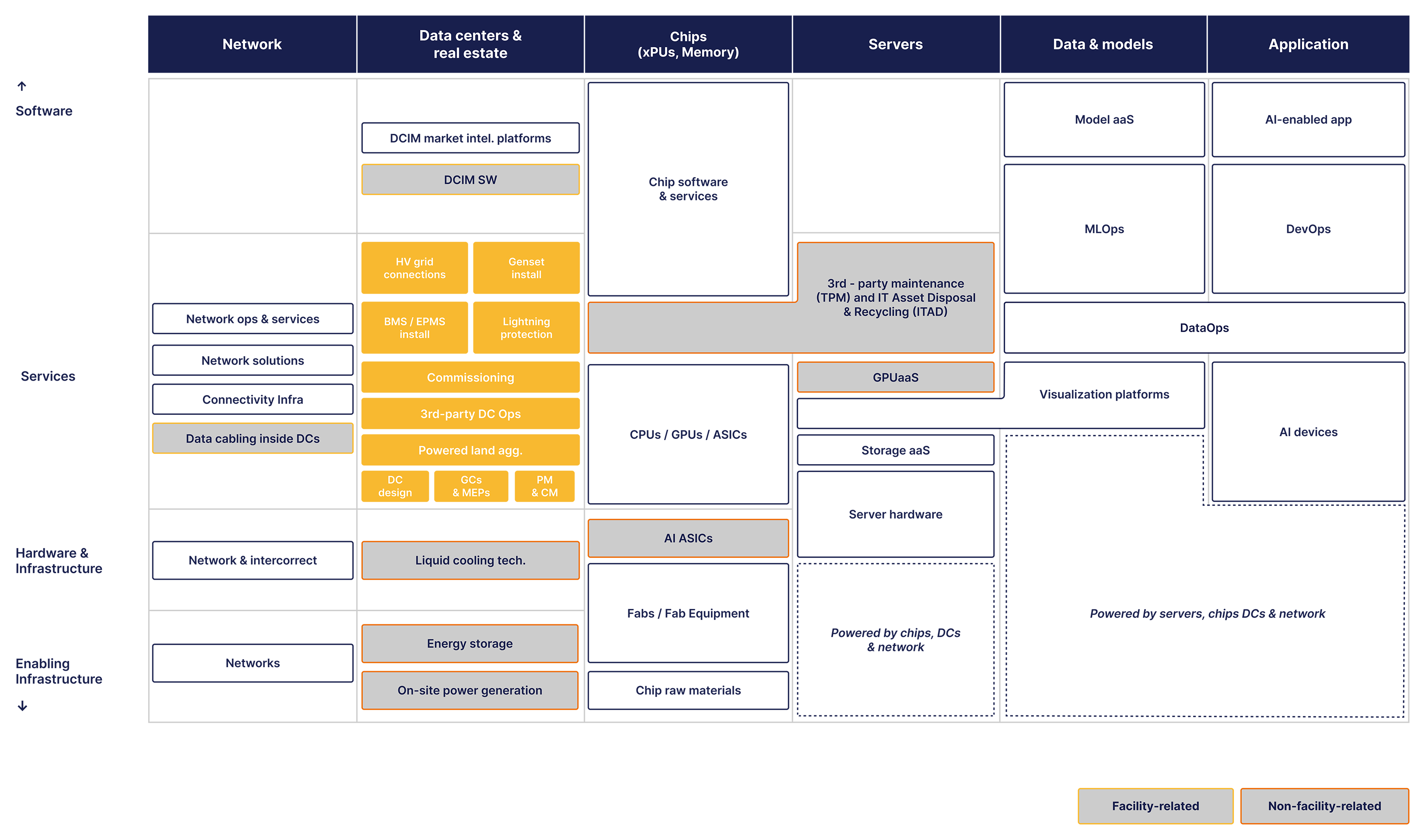
In this paper, we map investment opportunities into two broad categories: facility- or building-related services and software, and non-facility-related opportunities.
Data center value chain opportunities, example players
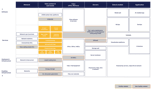
Data center value chain opportunities, example players
Broader investment opportunities than you might think
Investor attention typically concentrates on high-profile data center platforms. However, the data center value chain spans hundreds of adjacent product and service offerings. The appeal of these adjacencies lies partly in accessibility. They offer specialized or differentiated entry points into the same underlying growth theme, often without the highly capital-intensive requirements of building a large-scale DC platform.
No single “best” adjacency exists. Opportunities depend on business model, CapEx intensity, share of revenue that is recurring, margin levels, technology dependence, and durability of demand, among others.
Facility-related services and software: already seeing traction today
The largest area of current investment activity sits in and around facility-related services and software. This category covers businesses tied to the key systems that enable data centers to support IT equipment, ranging from strategy and site development to the intricate operational setup required for high-density AI environments.
Selection of potential DC-adjacent value chain investment opportunities
Selection of potential DC-adjacent value chain investment opportunities
Representative activity areas include:
-
Data center design
-
Project and cost management
-
Powered land aggregation
-
General contractors and mechanical, electrical, and plumbing (MEP) specialists
-
High-voltage grid connections
-
Generator set (genset) design and installation
-
Lightning protection
-
Data cabling inside the data center
-
Computational fluid design (CFD) solutions
-
Building management system (BMS) and electrical power management system (EPMS) design and installation
-
Data Center Infrastructure Management (DCIM) related software
-
Commissioning
Many facility-related services and software businesses, like the three examples below, are growing because data centers themselves are growing, making them direct beneficiaries of underlying market expansion.
Data center control systems
These systems bridge physical infrastructure and automated operations. Modern facilities rely on a BMS and an EPMS as the operational “brain” of the facility, bringing together activity areas like:
-
Environmental sensing: Deployment of sensors to measure heat, humidity, and airflow.
-
Controller integration: Installation of programmable logic controllers (PLCs) to manage equipment like chillers and power distribution units (PDUs).
-
Software logic: Automation that allows the facility to react in real-time.
Building management and electrical power management systems are informed by computational fluid dynamics (CFD) for predictive cooling. In turn, they inform DCIM systems for capacity, energy, and IT management.
-
Accessibility: High for specialized software firms.
-
Defensibility: Relies on proprietary algorithms and deep integration with hardware OEMs.
-
Risk: Primarily operational, centered on software reliability and cybersecurity vulnerabilities.
European players in this space include ABEC and DECI. Similar U.S. firms include RoviSys and Divcon.
Structured data cabling inside DCs
Low-voltage structured cabling is no longer a generic capability. It is a fundamental and increasingly complex step in deploying large IT estates in data center halls, particularly GPU cluster deployments. Any-to-any networking connectivity between GPU racks means a proliferation of optical cabling that doesn’t exist in traditional CPU deployments.
-
Accessibility / Defensibility: Higher for those with specialized certifications and scale.
-
Risk: Labor-intensive project delivery and sensitive to construction phase scheduling, albeit mitigated by faster AI chip lifecycles. Companies are rarely pure-play data center companies; they often serve other verticals (government, office, industrials, etc.).
European players that do this (in addition to other things) in a DC context include Onnec and Datalec. U.S. players include IES, E2 Optics, among many others in a fragmented landscape.
DC commissioning
Commissioning for data center systems is a six-level journey from design to handover:
-
Level 0 – Design review/commissioning planning
-
Level 1 – Factory testing
-
Level 2 – Pre-installation
-
Level 3 – Pre-functional
-
Level 4 – Functional testing
-
Level 5 – Integrated testing
The most critical phases occur at Levels 3 through 5, where systems undergo rigorous failure scenarios. During Level 3, static testing and initial power-ups are conducted, while Levels 4 and 5 involve integrated testing of cohesive system responses to simulated cooling or power failures.
Top-tier specialists now differentiate themselves by using proprietary cloud-based software to provide real-time progress tracking.
-
Accessibility/Defensibility: Limited by the technical expertise required, which strengthens defensibility for established specialists.
- Risk: Relatively high and reputation-driven, as any failure or delay during commissioning can cause significant project timeline slippage.
European players focused on this in a DC context include DECI and Global Commissioning.
Diversity of commercial models
Facility-related services and software can also offer more varied commercial models than DC platform ownership. Examples include project-led revenue, specialist services related to recurring revenue, and software-enabled sales and licensing revenue. For investors, these adjacencies can provide targeted exposure to the data center build-out without requiring a traditional platform investment.
Non-facility related adjacencies: Inflection points and technology shifts
Outside the facility/building layer, the value chain includes a varied set of adjacencies tied to compute, power, cooling, and IT lifecycle services. These are being accelerated by changes in AI workloads and power constraints.
Examples include:
-
DC IT services, e.g., graphics processing units as-a-service (GPUaaS) and third-party maintenance & IT asset disposal (ITAD).
-
Hardware and infrastructure, e.g., network hardware, liquid cooling technology, and AI application-specific integrated circuits (ASICs).
-
Enabling infrastructure, e.g., energy storage and behind-the-meter power generation.
These categories are propelled not only by baseline data center growth but, in several cases, are also being accelerated by changes in AI workloads, rack density, cooling requirements, and power constraints. Multiple areas experiencing such inflection points include liquid cooling, battery storage, behind-the-meter power generation, and GPUaaS.
This part of the market may offer stronger upside via recurring revenues (e.g., on-site power generation) and margin levels (AI ASICs) in selected niches. However, it is also less uniform and often dependent on timing, technology adoption, and market selection. Below we offer three examples illustrating the range of opportunities.
GPUs vs. AI ASICs
GPUs and AI ASICs are emerging as the main chips for large-scale AI training. ASIC players are segmented into platform providers and discrete accelerator providers. Cerebras is a good example of a formerly niche wafer-level supercomputer chip repositioned as an inference enabler. Their IPO last month was a good bellwether for market support of hyperscaler-independent AI ASIC vendors; it turned out to be the largest semiconductor IPO in history.
GPU-as-a-Service (GPUaaS) providers, or neoclouds, offer specialized IaaS focused on high-end compute. Pricing is notably competitive compared to hyperscalers, as neoclouds aren’t yet spending billions on building and maintaining up-the-stack tools and services the way hyperscalers have done in the CPU world. On average, GPUaaS providers are over 40% cheaper than traditional hyperscalers for GPU-heavy workloads due to large-scale bare-metal contracts.
Capital flowing into chip builders (AI ASIC companies) is often more early-stage VC money, given the risk profile. For neoclouds, we are increasingly seeing interest from tech investors in small and mid-size neoclouds. One example of this is Brookfield’s new AI infrastructure fund acquiring Ori, a small U.K. neocloud, and merging it with Radiant. Longevity risks for any individual player remain high, as there are over 100 neoclouds out there and the relative nascency of the AI workloads they are facilitating.
Thermal management and the move to liquid
Generative AI workloads demand new cooling solutions. Liquid cooling is expected to increase in frequency, moving from air-based airflow to liquid contact via technologies like "cold plate" or "direct-to-chip," which brings liquid pipes directly to the rack, whereas "immersion cooling" involves total liquid contact with the hardware.
Vendors are categorized into:
-
Free air
-
Chassis-enclosed immersion
-
Open-bath immersion (single or two-phase)
Procurement cycles are maturing. Historically, immersion cooling had a two-year sales cycle, but this is shortening as strategic global alliance partners lead deployments. Design steps typically take over three months to ensure no adjustments are needed during deployment.
-
Accessibility: Currently restricted to select hardware innovators, many driven by Nvidia’s NVL rack reference designs.
-
Defensibility: Strong, through patents and technical barriers.
-
Risk: Moderate, tied to the rapid evolution of cooling standards and the potential for technological obsolescence.
Energy storage and BESS
Battery energy storage systems (BESS) are transitioning from niche applications to potentially large market opportunities alongside DCs. They are used for peak shaving (reducing costs during peak periods), renewables integration (storing excess solar or wind), and grid services (providing frequency regulation), and could temporarily offset or possibly replace traditional DC UPS and diesel gensets while providing benefits upstream to the public utility grid.
-
Accessibility: Moderate for energy service firms.
-
Defensibility: Tied to long-term power purchase agreements (PPAs), grid-balancing contracts, and DC offtake contracts.
-
Risk: Primarily regulatory and market-based, dependent on shifting utility pricing and government energy policies.
Aligning growth and business models
The most attractive opportunities are those in which market growth, business-model quality, and investor requirements align. For investors seeking to invest in DCs in less traditional ways, the value chain offers a specialized and increasingly critical set of opportunities, with a broad range of entry points.
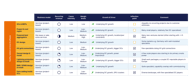
Potential DC-adjacent value chain investment opportunities
Key business characteristics (1 of 2)
Potential DC-adjacent value chain investment opportunities
Key business characteristics (1 of 2)
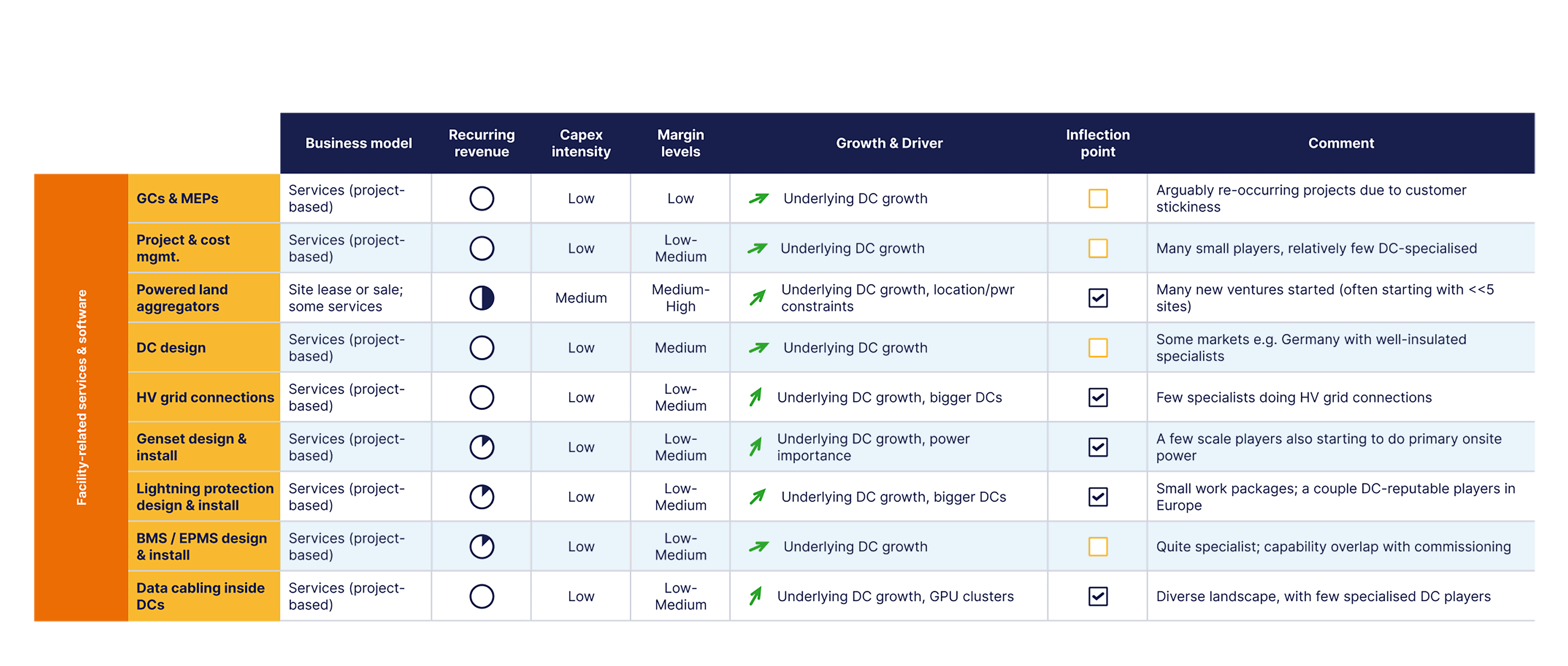
Facility and building-related services and software form the broadest adjacent opportunity set and are closely linked to continued sector growth. Non-facility-related adjacencies are also proving compelling, where technology changes are creating stronger tailwinds.
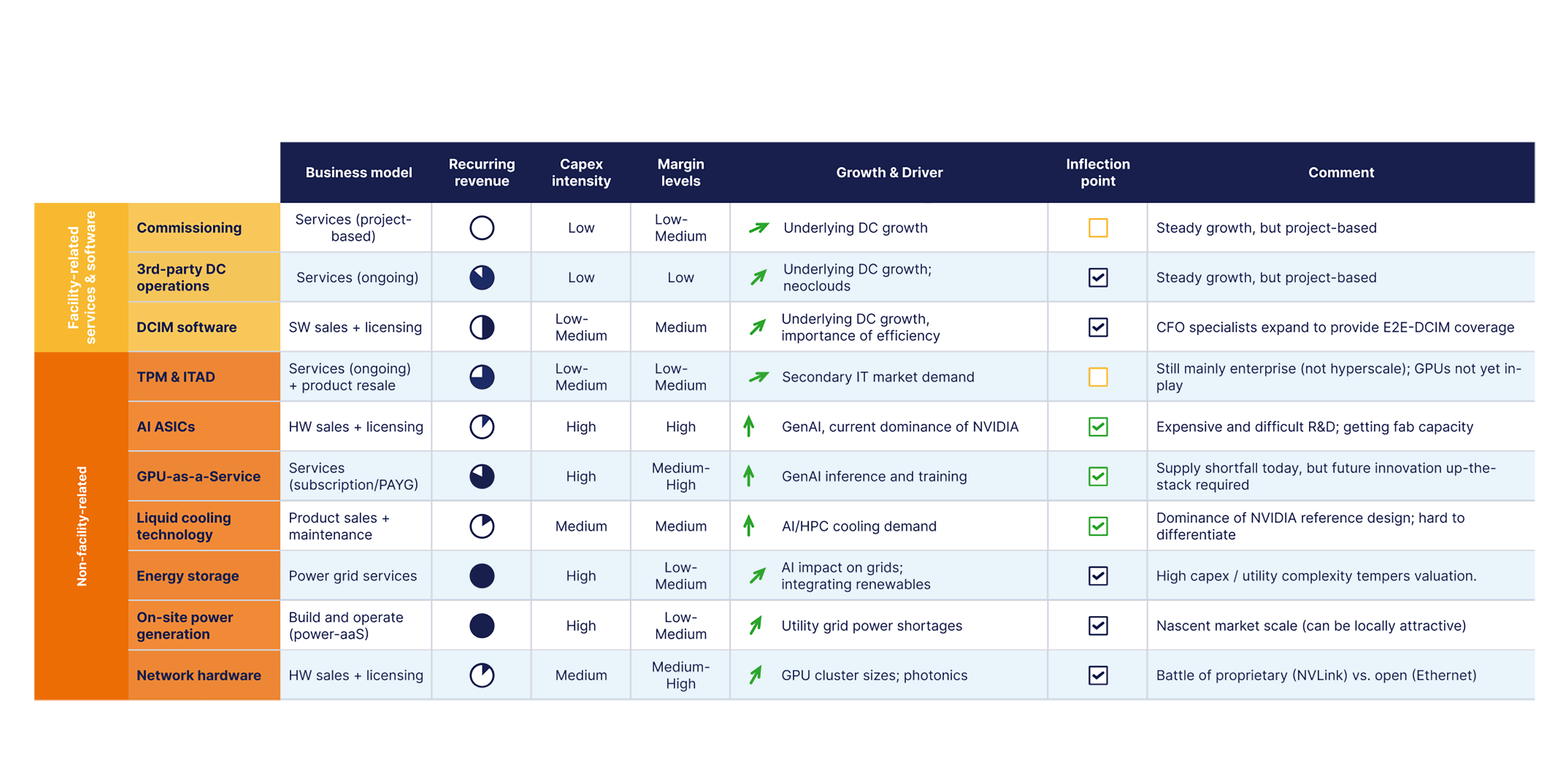
Potential DC-adjacent value chain investment opportunities
Key business characteristics (2 of 2)
Potential DC-adjacent value chain investment opportunities
Key business characteristics (2 of 2)
Data center investment expertise
Altman Solon has deep experience across the DC and AI value chain and helps investors identify and assess opportunities. Drawing on sector expertise across data centers, digital infrastructure, and adjacent technologies, Altman Solon helps clients and investors:
-
Map the relevant adjacency landscape, including potential upcoming deals, and prioritize the most actionable segments
-
Support investment screening, diligence, and value-creation planning across the broader data center ecosystem
- Distinguish between opportunities driven by baseline data center growth and those shaped by technology or business model inflection points
-
Conduct detailed commercial and technical due diligence by assessing business-model characteristics, market structure, and competitive positioning most suited to investors based on their underlying requirements as well as technology feasibility, obsolescence, and risk.
-
Evaluate risk profiles across facility-related and non-facility-related adjacencies.
Contact Altman Solon today for an evaluation of data center adjacency opportunities aligned with your investment objectives or further discussion.


Insights
Insights | August 2026
Insights | August 2026
Insights | August 2026