



GTA VI Will Smash Sales Records but Won't Save the Gaming Industry
November 2026
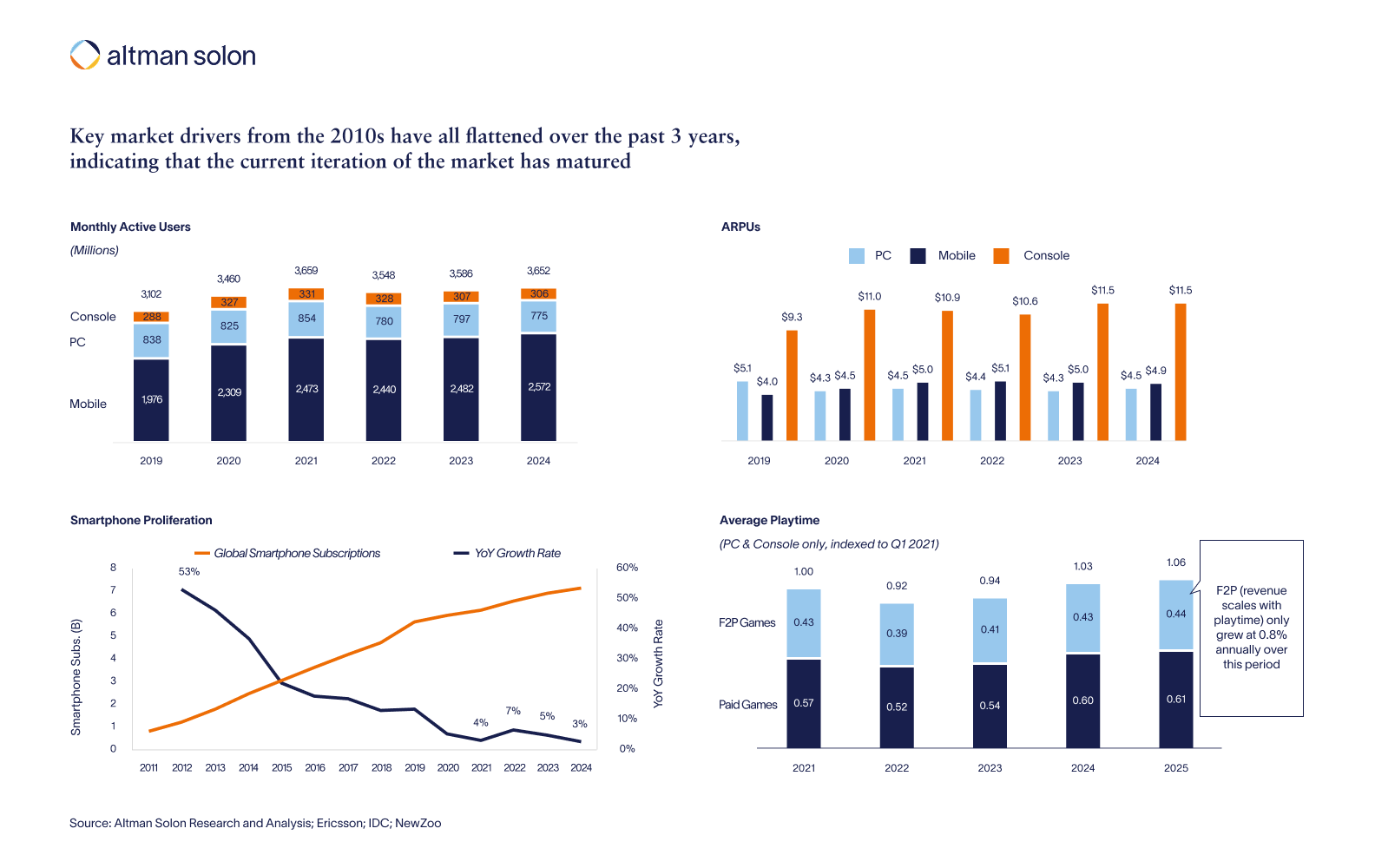
Grand Theft Auto VI (GTA VI), premiering on November 19th, is poised not only to break records in gaming, with predictions of between $3 to $5 billion in sales in its first week, but also to become one of the most valuable media franchises in the world. However, GTA VI's success will not be enough to rescue the video game industry, which has seen tepid growth in players, revenues, and revenue per player since 2021. For sustained growth, the video game industry needs to evolve to meet the preferences of a new generation of consumers, which means embracing new platforms, genres, and monetization formats to better compete with other forms of digital entertainment.
GTA VI, as it’s currently conceived, won't transform the industry; instead, it will serve as the pinnacle of the AAA era of console and PC gaming. However, GTA VI could serve as the “killer app” that introduces players to new market concepts, and with some strategic additions, it could be the catalyst that evolves the video game industry into a new era of form and growth.
GTA VI is poised to be the highest-grossing game ever
GTA VI is poised to not only break records in the video game industry, but it could also go down as the highest-grossing media title of all time and firmly cement the Grand Theft Auto IP among the pantheon of media elite such as Mickey Mouse, Star Wars, and the Marvel Cinematic Universe. Industry consensus is that GTA VI will easily surpass the lifetime sales of its predecessor, GTA V, which is third all-time at over 230 million copies sold since its release in 2013. And, at a starting price of $79.99 for the base game ($99.99 for the Ultimate Edition), it could become the highest grossing video game title of all time, exceeding evergreen franchises like Fortnite, Pub G, and Dungeon Fighter Online. That could put game sales revenue at approximately $20 to $25 billion, and with microtransactions, GTA+ subscriptions, and downloadable content, it’s easy to see a path to $30 to $50 billion of lifetime sales for the game.
GTA VI’s release is fast becoming a cultural phenomenon that promises to have a socioeconomic impact on par with the Super Bowl or World Cup. There are reports that employees in the U.S. are planning to use their PTO days in order to binge it around the Thanksgiving holiday. Houston Rocket’s center Steven Adams jokingly predicts pro player performance will dip around the game’s launch date. In the 24 hours preceding GTA VI's trailer, released exclusively on Netflix, pre-order sales increased by over 400% meanwhile; rival publishers have sped up their own game releases to avoid competing head-to-head for consumer spend. GTA VI isn’t just driving revenue for Take-Two; it is impacting income statements across the business world.
GTA VI won't fix broader gaming industry challenges
However, GTA VI is unlikely to transform the industry the way GTA V did, and it won’t fix the problems that have plagued the video game industry since the boom times of the early 2020s. Take-Two and Rockstar transformed the video game market when they released GTA Online in October 2013, two weeks after GTA V, in the same digital world but freely accessible. It’s hard to see how GTA VI and its inevitable online edition, set in the fictional city of Leonidas, will meaningfully surpass what its predecessors did.
In fact, the online edition is scheduled to roll out in 2027, months after the game’s console release, and the initial fervor has died down. Add the challenge of migrating players from the current online game (based in Los Santos) to the new version (in Leonidas) and Take-Two will struggle to merely match the player adoption that the current online edition has generated since 2013.
Instead, GTA VI will serve as the capstone of a bygone era of the video game industry where epic single-player role-playing games capture hundreds of hours of attention from relatively hard-core gamers. Unfortunately, younger consumers have not adopted this type of game on the same scale as their millennial and boomer elders. To capture Gen Z and Gen Alpha attention and for spending to return to above-inflation growth, the video game industry needs to undertake dramatic transformation to adopt new game genres, access platforms, and monetization formats.
Gaming's path to growth: pricing now, new players later
Today, the video game industry is not attracting new players, and the players it does have are not spending more. While the underlying drivers of KPI erosion can be debated, these two fundamental facts have led to a flat market size (no material growth) since 2021.
Short-term: raise revenue per player via pricing, ads, and e-commerce
While attracting new players requires that the industry adopt longer-term, strategic initiatives and make bets on unproven content, growing average revenue per user (ARPUs) can be addressed in the near term by enacting the following initiatives:
- Raise prices: AAA games had been stuck at $60 for nearly 20 years when NBA 2K21 tested the $70 price point in 2020. Since then, a few games have tested the $80 price point (Mario Kart 8, Starfield), but in most cases players could access the game for less with other buy-ins to the publishers’ ecosystem. GTA VI has already launched pre-orders priced between $79.99 and $99.99 (for Standard or Ultimate editions), and early reports suggest nearly 90% of pre-orders are for the premium $99.99 version. Avid gamers have shown limited price sensitivity for premium content, so publishers should raise prices at launch.
- Adopt hybrid monetization: For years, industry executives and gamers have pushed back on hybrid monetization, especially ads or in-game purchase offers after having already paid for the game itself. However, as we've seen with Netflix and Disney+, among others, publishers eventually need to look at hybrid monetization to continue increasing ARPUs during periods of weak consumer spending. We recently saw Xbox announce an ad-supported version of Game Pass, and earlier this year Electronic Arts launched EA Advertising, a programmatic ad server designed to place ads within EA Sports titles. We’re likely to see an influx of ads to the ecosystem in places where they didn’t exist before, and if done properly, these ads will not degrade the user experience.
- Enable e-commerce: Finally, the industry should be aggressively pursuing e-commerce within games, for example, imagine ordering Uber Eats in the Fortnite lobby while waiting for friends to join. Roblox has been the first to test this type of monetization model at scale when it partnered with Shopify and Walmart, enabling product purchases within the digital world. Given how much information publishers collect on their players and the relatively captive mid-game audience, e-commerce could drive tremendous growth for the industry.
Long-term: attract Gen Z and Gen Alpha users with social, connected TV, and cloud-based play
While the above measures will enable the industry to grow the average revenue from gamers, it will not solve the challenge that new players are not entering the video game ecosystem. Research suggests that Gen Z and Gen Alpha prefer social and cooperative play and gravitate toward user-generated content platforms; additionally, they prefer to access games on a phone or tablet. This contrasts with older gamers who grew up playing single-player epics on console games.
The answer is simple in theory but challenging in execution: the industry needs to provide entertainment options that are compelling for new generations of consumers and can more effectively compete against digital media alternatives like social media, short-form videos, and, increasingly AI apps. To do this, the industry needs to try new things and be quick to support and invest in those that show signs of broad appeal with younger consumers:
- New genres (social and party games): Younger and casual gamers are craving social experiences where they can hang out, compete against or collaborate with their friends.
- New platforms (connected TV): Most households have connected TVs, and most consumers have smartphones, providing an installed base of hardware to achieve mass-market adoption of new games.
- New technology (cloud game streaming): Younger gamers are spending more time on UGC platforms like Roblox, Fortnite, and Minecraft than social media.
How GTA VI can transform the industry
While GTA VI will be phenomenally successful, it likely won’t transform the industry in the same way that its predecessor, GTA V, did when it introduced GTA Online in late 2013. However, it will have an embedded player base and compelling content (the makings of a “killer app”) that can take transformational steps and bring its avid fans along.
There are two strategic initiatives that GTA VI could pursue that would truly transform the video game market: create a true metaverse ecosystem and develop a cloud-hosted streaming platform that will allow people to access GTA VI without the need to buy a console or gaming PC.
Leverage GTA to create a broader metaverse platform
The term “metaverse” rose and fell in popularity during the early 2020s. However, the concept has endured and, in fact, GTA Online is one of best examples of a metaverse in action today. GTA VI will carry the Online torch when Take-Two releases GTA VI Online in 2027, and with a few tweaks it could create a digital ecosystem that further evolves the metaverse concept.
First, Take-Two needs to open up the GTA ecosystem beyond the lawless world of Los Santos or Leonidas. In fact, those worlds should be unique branches of a much larger metaverse that supports a broader array of digital entertainment. GTA Online should be the “anything goes” sandbox where users can navigate a spectrum of edgy, high-stakes scenarios. The GTA world is entertaining and intense; it should be an experiential offshoot of a larger metaverse platform, not the main attraction.
Second, GTA Online needs to enable a broader array of e-commerce options. While a user is in the safe areas of Take-Two’s metaverse, they should be able to buy real world goods and services and transfer various forms of currency to other players. The first step is developing a world that people want to spend time in. Take-Two is already well on its way to doing this. The next step is to enable a rich set of entertainment and economic experiences, and doing so would free the metaverse concept from being confined to a single game’s digital world.
Develop cloud streaming delivery model for GTA VI
The biggest limiting factor for GTA VI’s addressable market is that prospective players must purchase an expensive console or gaming PC. Imagine how many people would buy GTA if they could play it on their existing connected TV, and only had to pay for the game, plus a Bluetooth controller? If Take-Two could bypass the console or PC and deliver GTA VI in a direct-to-consumer model, it could dramatically expand its total addressable market and increase revenue, driving higher margins as they avoid the platform distribution fee.
There have been some noteworthy attempts at bringing cloud gaming to the masses in the past. Google launched Stadia in 2019 and shut it down in 2023, unable to figure out the technical and commercial models around the access technology. However, technology continues to advance, and Microsoft has had a valid cloud gaming offer for many years now.
GTA VI can usher in a new era in video games
The video game industry needs to evolve dramatically to return to sustained growth, and regardless of how it happens, it will be best achieved on the back of a killer app. GTA VI could be the catalyst, and if leveraged properly, the vehicle that carries the industry into a new era of prosperity.
How Altman Solon can help
Altman Solon helps gaming publishers and platforms adapt product strategies, monetization models, and growth plans.
- Product & business model evolution
Advising on pricing, live services, subscriptions, and free-to-play models.
- Content & pipeline strategy
Helping developers prioritize genres, platforms, and innovation areas aligned with audience trends. - Platform partnerships & distribution
Structuring deals that maximize exposure while preserving long-term value.
- M&A & growth strategy
Supporting transactions and long-term scale decisions across the gaming ecosystem.
Related topics

Perspectives
May 2026
What’s Next After 5G? How AI May Unlock New Applications & Innovation
What’s Next After 5G? How AI May Unlock New Applications & InnovationMarch 2026
From Hype to Hard Choices: What MWC26 Signals for Telcos and Their Ecosystems
From Hype to Hard Choices: What MWC26 Signals for Telcos and Their EcosystemsOctober 2025