



The Three Pillars of the 6G Business Case: Bits, Tokens, and Sensing
November 2026
In telecommunications, talk of the next G has picked up. In June 2026, 3GPP approved the Release 21 timeline. The first release will include normative 6G specifications, with core specifications due to be completed in early 2029. Ericsson expects the first commercial 6G systems to be ready in 2030. 6G is not yet fully defined, but it is starting to take shape.
Two years ago, we published our perspective on the 5G business case for wireless carriers. Our core point was that the real value of 5G for mobile network operators (MNOs), at least in its first five years, had little to do with cutting-edge use cases. It came from driving the cost per gigabyte down, which let MNOs protect margins and keep capital intensity in range as wireless traffic kept compounding. Over a longer horizon, the better network would become a platform for product and ecosystem innovation. We still hold that view.
Like 4G and 5G, 6G will likely start as an improved bit pipe: more capacity at a lower cost per gigabyte. While that alone would justify much of the investment, two new elements have the potential to set the bar and raise mobile networks' monetization potential: token delivery and sensing. We believe the 6G business case has three pillars: bits, tokens, and sensing. MNOs can already assess the first; the next two waves should bring new revenue opportunities, as well as new kinds of risks.
The 6G business case rests on three pillars
Three distinct but interconnected parts, built on assets MNOs already own
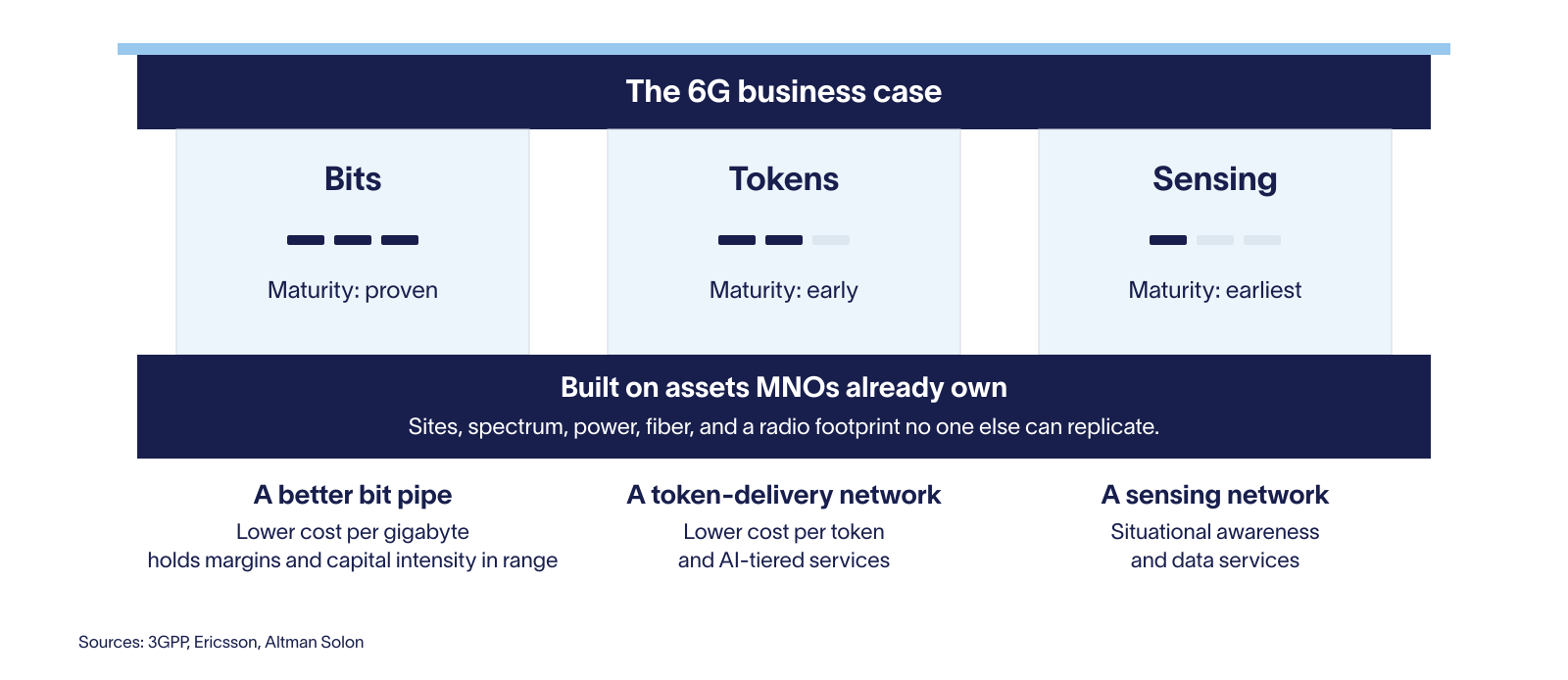
The first pillar of 6G: A better bit pipe, again
“6G's first pillar does not need a single new use case to pay for itself.”
6G's first pillar follows the same logic as our 5G case. Demand keeps growing: Ericsson’s June 2026 Mobility Report shows global mobile traffic up 22% year over year to 210 exabytes per month and is projected to double between 2025 and 2031. Revenue does not keep pace: our research shows U.S. traffic grew at approximately 29% a year between 2017 and 2023 while carrier revenue grew at approximately 3%. Our 5G analysis showed that cost per gigabyte must fall by a factor of 2.8 between 2023 and 2029 just to hold margins if revenues stay flat.
By 2030, 5G will run into the same wall 4G hit around 2019. Available mid-band spectrum will be deployed, spectral efficiency gains will flatten, and densification, the most expensive lever, will be all that is left. A major improvement in 6G’s spectral efficiency could alter the economics of network capacity, reducing the cost of transmitting data. Early 3GPP decisions point to an evolutionary air interface: 5G channel codes will be largely reused, and supported bandwidths will run from 3 megahertz to 400 megahertz.
Traffic is also shifting direction. Ericsson also reported that 43 of the 55 service providers it measured saw uplink traffic grow faster than downlink, and its scenario modeling has uplink traffic three times higher in 2031 than in 2025, or five times in a high-adoption case. The 6G uplink improvements belong to the bit-economics pillar, but much of the uplink growth comes from AI, which leads directly to the second pillar.
The second pillar of 6G: From bit pipe to token-delivery network
“Cost per token, not just cost per gigabyte, will increasingly decide how well a mobile network performs and what it earns.”
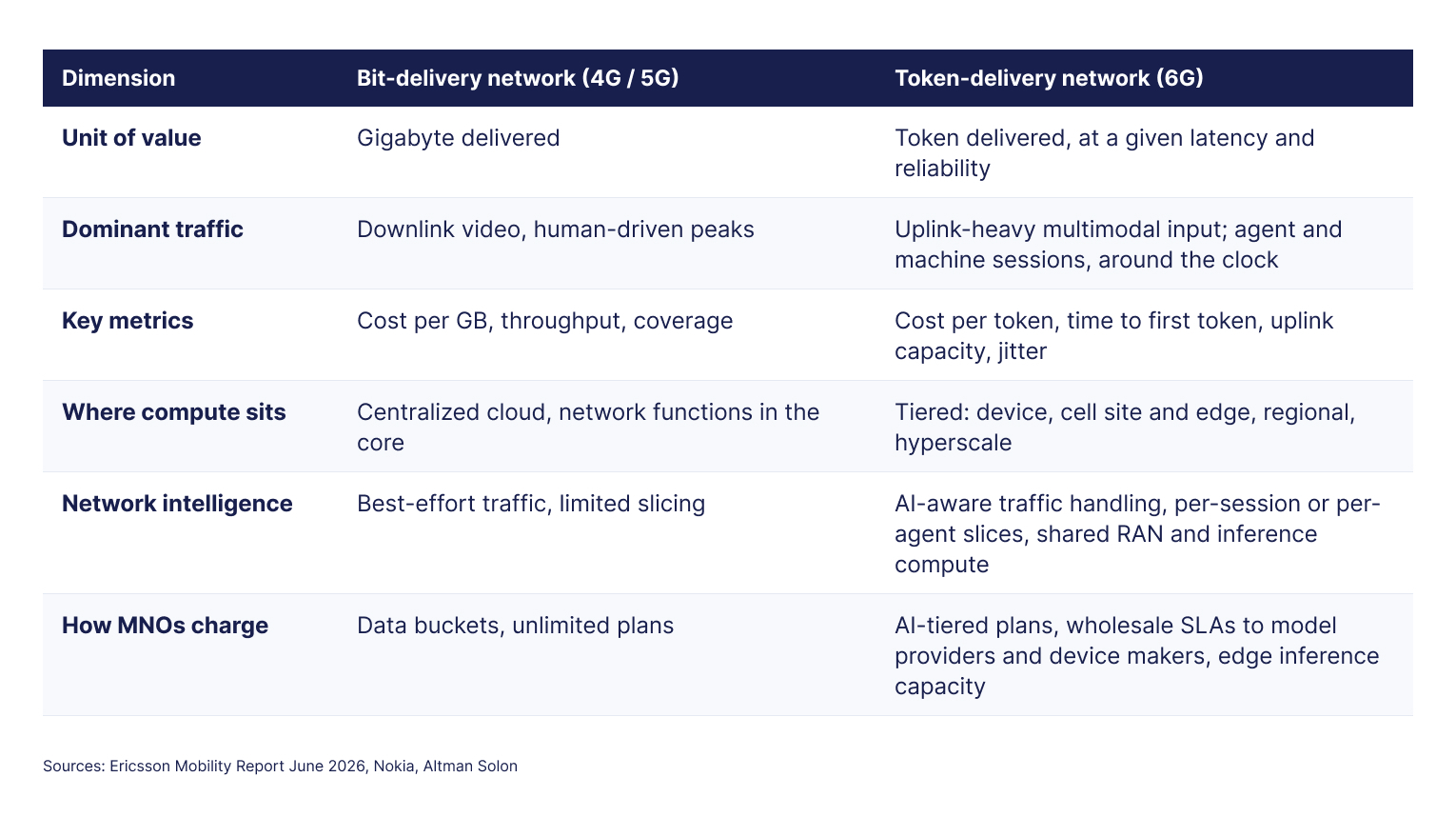
As AI becomes even more integrated into our digital and physical infrastructure, mobile networks are quickly becoming token-delivery networks as much as traditional bit pipes. Consumers and B2B verticals will use a mix of AI models across many use cases, and every answer arrives as a stream of tokens. Increasingly, requests don't come from a person typing. They come from an agent, a pair of AI glasses, a vehicle, or a robot. The scale is already large. China’s National Data Administration reported 140 trillion AI tokens processed daily in March 2026, a 1,400-fold increase from the start of 2024. China’s three operators launched commercial AI token packages in May.
Token traffic behaves differently from video. It is uplink-heavy because devices send camera frames, voice, and context to the model. It is latency-sensitive at the start of each exchange: time to first token decides whether a voice agent feels natural. It is bursty and session-based, and as agents and robots take over more, it runs around the clock rather than following human usage peaks. And value per bit varies enormously: a few kilobytes of tokens that complete a transaction can be worth more than a gigabyte of streamed video. A network that treats every bit the same will underprice some traffic and overspend on the rest.
From a bit-delivery network to a token-delivery network
How the operating model of the mobile network shifts as AI traffic grows
We have already seen this shift in wireline networks. U.S. long-haul fiber providers have signed multi-billion-dollar private connectivity deals with hyperscalers to link AI data centers, and network design is moving to follow where inference runs. In mobile, the precursors are AI-RAN platforms that run radio processing and AI inference on shared hardware at the cell site or edge. NVIDIA and Nokia have signed a $1 billion partnership around an AI-RAN platform for 6G. On October 21, Supermicro, Nokia, and NVIDIA announced an edge node that can deliver up to 1.6 PFLOPS of FP4 inference at the cell site. SoftBank has demonstrated how spare GPU capacity at the cell site, identified by its AITRAS orchestrator, can host third-party inference. We expect 6G to standardize much of this with an AI-native core forming part of the Release 21 system architecture work due in June 2028.
Token-delivery opportunities for MNOs fall into four groups:
The first is AI-tiered connectivity: plans or slices that guarantee uplink and latency for AI wearables, agents, and vehicles, sold to consumers or wholesale to model providers and device makers who need predictable delivery.
The second is edge inference capacity: sold as GPU-as-a-service from AI-RAN hardware that would otherwise sit idle off-peak; Omdia estimates the AI-RAN market could exceed $200 billion cumulatively by 2030.
The third is sovereign and regulated inference: for governments and regulated industries that need data to stay in-country.
The fourth is internal: just as cost per gigabyte was the margin lever of 4G and 5G, cost per token will be a margin lever of 6G, whether MNOs charge for tokens directly.
The third pillar of 6G: The network as a sensor
“ISAC lets the mobile network see the physical world, not just the devices connected to it.”
Sensing, or integrated sensing and communication (ISAC), is 6G’s furthest-out use case and is arguably the most innovative and exciting capability. ISAC leverages the radio signals the network already transmits. By analyzing how those signals bounce off objects, the network can detect, track, and characterize items that don't carry SIM cards, much as radar does, from sites that are already built. Combined across many sites, the network can build a real-time, three-dimensional map of the physical world it covers.
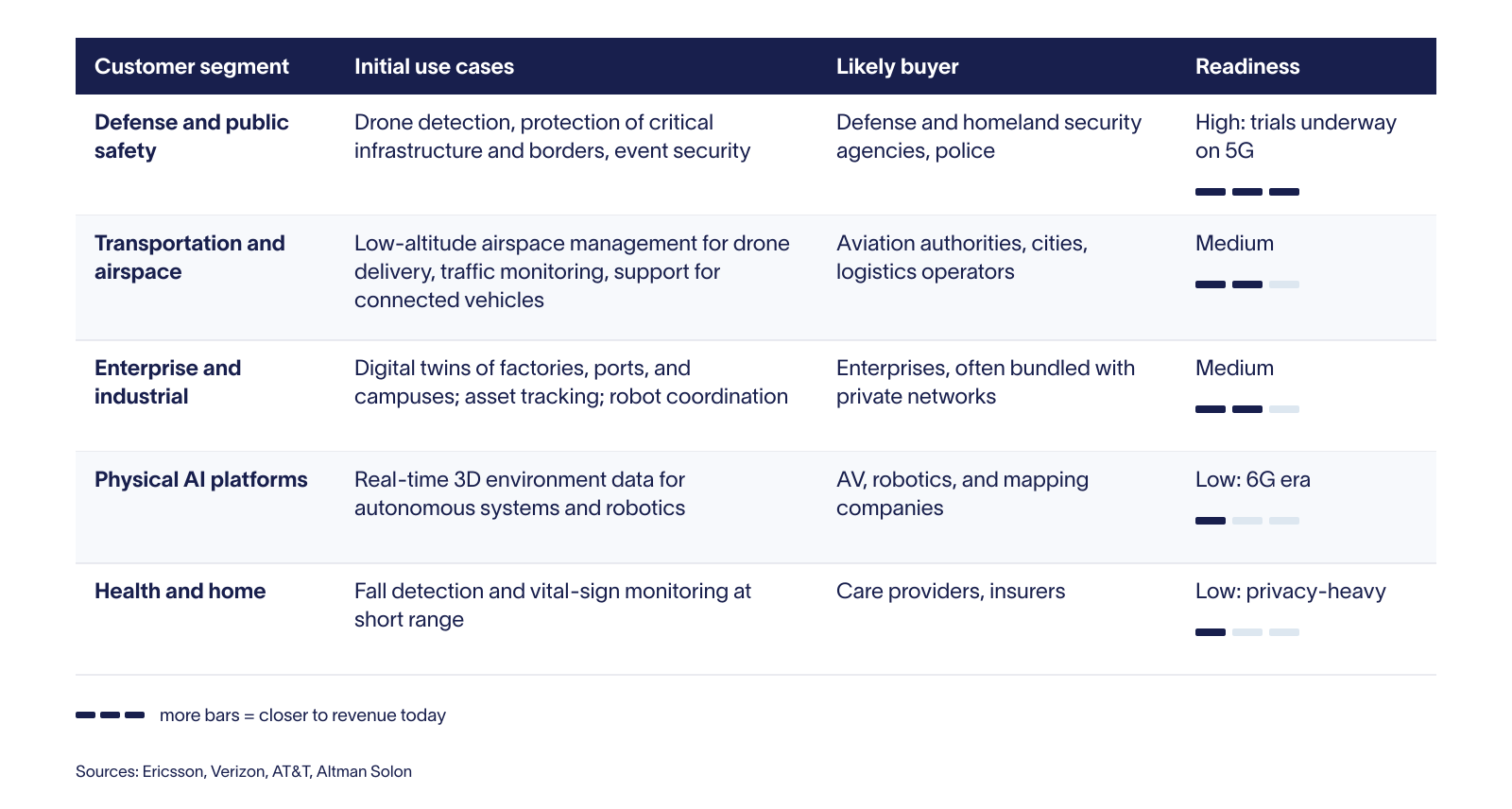
ISAC has progressed out of the lab and into standards this year: studies that began in 3GPP under Release 19 are expected to inform early 6G specifications. Trials so far run on 5G radios and focus on drones: Ericsson demonstrated live drone detection at its U.S. headquarters in Plano, Texas; AT&T and Ericsson ran another drone-detection demonstration near AT&T Stadium during the FIFA World Cup; Verizon made ISAC one of two anchor themes of its 6G Innovation Forum; Cohere Technologies won a U.S. Department of War contract to turn cellular networks into sensing systems; and Ericsson and Finnish operator Erillisverkot tracked drones at Helsinki’s Vuosaari Harbor in September. We believe early applications will be in defense and public safety, with wider commercialization in the 6G era.
The longer-term prize is physical AI. Robots, autonomous vehicles, delivery drones, and industrial digital twins need a continuously updated model of the world around them. Today, onboard sensors are limited by their line of sight; a sensing network sees around corners, across a whole city, nonstop. MNOs already hold the sites, spectrum, power, and backhaul to provide it, which makes the sensing network a likely critical long-term enabler of physical AI.
Where the sensing network could earn revenue
Illustrative ISAC use cases by customer segment
6G opportunities and challenges for MNOs
“The two newer pillars are where the upside lies, and where MNOs have the least experience capturing it.”
Tokens and sensing open revenue pools that are not priced per gigabyte. The last three generations failed to do this at scale. Both tokens and sensing reuse assets MNOs already own: sites, spectrum licenses, power, fiber, and a radio footprint no one else can replicate. Both also come with natural anchor customers, model providers, and device makers for tokens and governments for sensing that can underwrite early deployment. The challenges are just as real, and they differ by pillar.
Token delivery and sensing challenges: value capture, capital, and trust
Both pillars face the same core test: capturing value from revenue that is not priced per gigabyte. For token delivery, the barriers are competitive and financial. Hyperscalers and model providers already own the customer, and GPUs at cell sites add CapEx and power draw before demand is proven. For sensing, the barriers are demand and trust. Buyers are fragmented and slow; the data may be worth more to platform players than to MNOs, and detecting unconnected people raises privacy and dual-use concerns. Standards and regulation remain unsettled for both, so MNOs will need new capabilities: per-token pricing and model-provider partnerships for tokens, and outcome-based offers such as detection, maps, and alerts for sensing.
Key challenges for the two newer pillars
What MNOs need to solve before tokens and sensing pay off, rated by difficulty
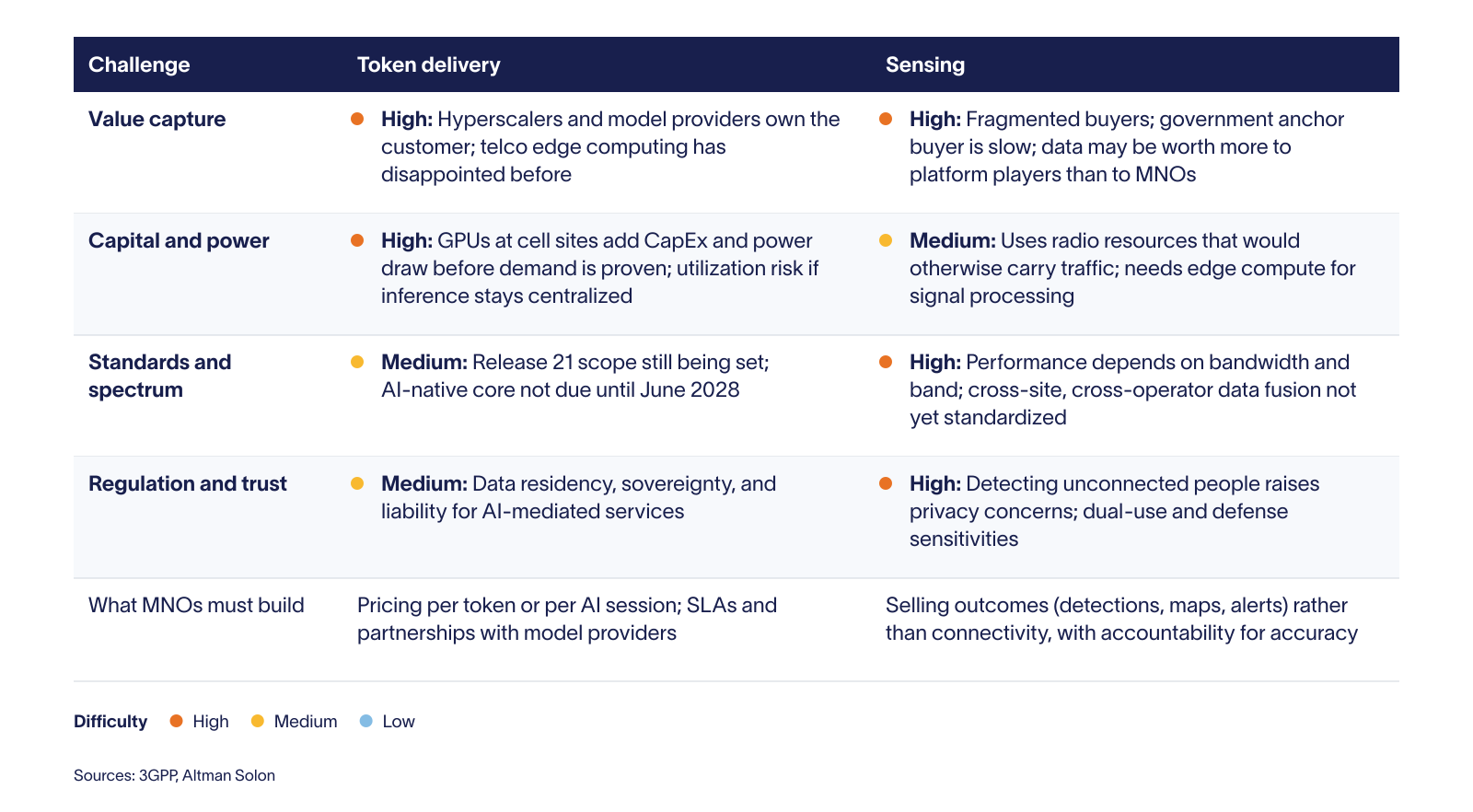
Of these challenges, value capture is the most difficult for both. The 5G-era edge computing push is a cautionary tale; Cox, for one, folded its edge business into its private networks unit. To avoid a repeat, MNOs need to anchor token delivery and sensing offers in what others cannot copy: the radio link itself, precise location, licensed spectrum, a dense site grid, and trusted relationships with governments and regulators.
It’s still cyclical
“The bit pipe will pay for 6G. Tokens and sensing will decide whether 6G finally lets revenue grow with traffic.”
Our 5G work showed that carrier CapEx moves in waves, coverage first and capacity second, with each new G lifting the average: from around $29 billion a year in the U.S. during 4G to approximately $36 billion a year during the 4G-to-5G transition. As commercial 6G is expected around 2030, 6G coverage spending should start to build late in the decade as the 5G capacity cycle peaks. As with 5G, the first pillar will justify that cycle on its own.
Tokens and sensing are options on top of that base case, and they should be brought in earlier in the process. That means shaping Release 21 content over the next two years, planning sites with the power and space for edge compute, running sensing pilots with public-sector anchor customers, and building token-aware pricing and partnerships before 2030, not after. For three generations, traffic has grown roughly ten times faster than revenue. 6G is the first generation with two credible ways to change that ratio.
How Altman Solon can help
Altman Solon helps telecom operators, infrastructure providers, and investors turn the transition from 5G to 6G into a clear set of choices on network strategy, economics, and new services. Typical support includes:
- 6G strategy and investment case development: Technology roadmap, rollout scenarios, spectrum considerations, and business-case tradeoffs for performance vs. cost.
- Network economics and cost-efficiency programs: Target architecture, vendor/partner strategy, operating model, and automation levers to improve unit costs while meeting performance expectations.
- New growth opportunities enabled by next-generation networks: Use-case prioritization, go-to-market design, ecosystem partnerships, and commercial validation for emerging applications.
Related topics


Perspectives
November 2026
GTA VI Will Smash Sales Records but Won't Save the Gaming Industry
GTA VI Will Smash Sales Records but Won't Save the Gaming IndustryMay 2026
What’s Next After 5G? How AI May Unlock New Applications & Innovation
What’s Next After 5G? How AI May Unlock New Applications & InnovationMarch 2026